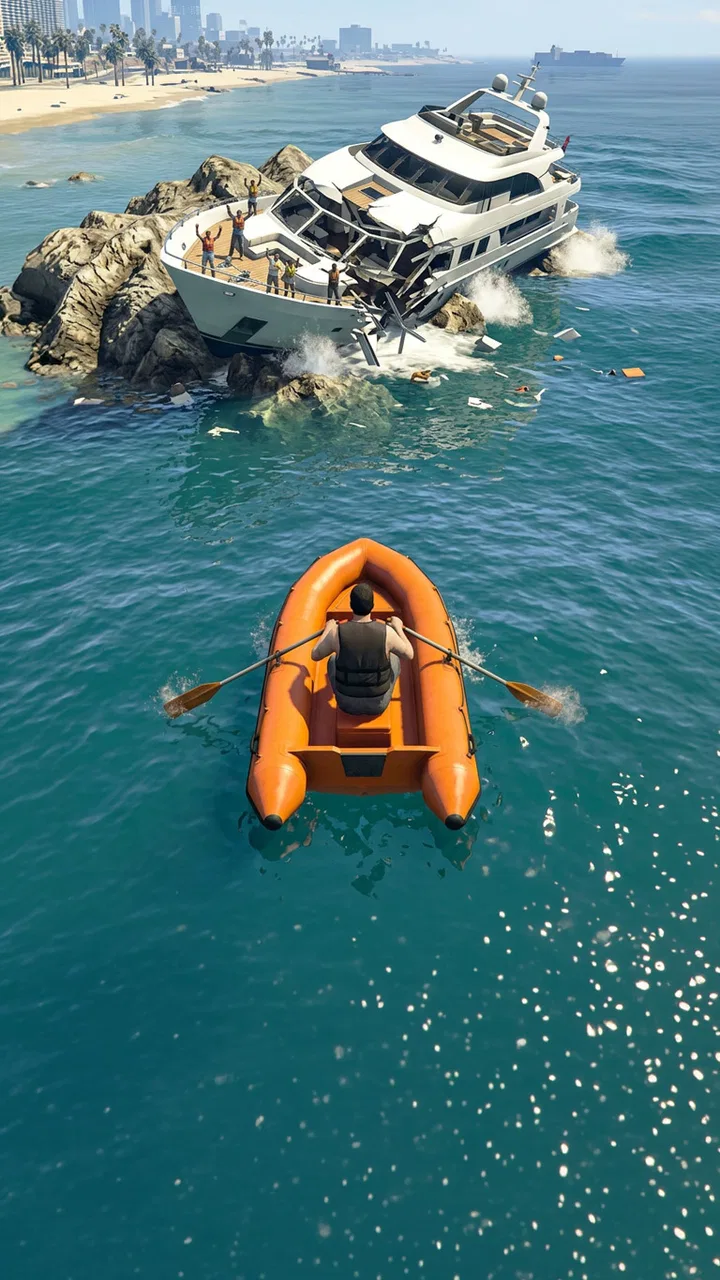
Boat Transport Simulator
- 4.3
- Rating
- 1.00M
- Installs
- Free
- Price

 Analysis by App-foxy
I approached Boat Transport Simulator expecting a straightforward boating game, but its appeal is more specific than that. This is a simulation game built around rescuing passengers, improving boats, and gradually shaping a water fleet. That combination makes it a better fit for players who enjoy small, repeatable management decisions than for anyone looking for a realistic sailing simulator or a fast arcade racer.
My first decision point would be simple: do you want your boat to feel like a vehicle you drive, or like a tool you develop over time? Here, the second idea matters more. The pleasure comes from turning successful trips into a stronger operation, then using that progress to handle the next challenge more comfortably. It is free to start, rated Teen, and works on Android devices running version 7.0 or later, so it is accessible to a wide range of players.
The game comes from Skyloft Yazılım Bilişim ve Anonim Şirketi. It has built a 4.5 average from around 7,100 ratings and has passed one million installs, which suggests that the central loop has found an audience. I would still treat those figures as a starting point rather than a guarantee: simulation games can feel very different depending on whether you like gradual upgrades, repeated routes, and practical objectives.
You May Also Like

 Blood Strike: 2.5 Anniversary
Blood Strike’s Loadouts Turn Every Drop Into a Tactical Gamble
A close look at Blood Strike’s custom loadouts: how fast access to signature weapons reshapes its battle royale rhythm, rewards preparation, and narrows the gap between fights.

 Pandora - Music & Podcasts
Pandora’s Music Is Easy to Start, but Harder to Recover
Pandora’s strength is its low-effort path from a seed to a station. Its weak spot is how much confidence it asks you to place in connection, setup, and quiet recovery.

 8 Ball Pool
 Is Built on Rivalries, Rematches, and Routine
A close look at the rivalries, rematches, shared routines, and unanswered safety questions that turn a quick pool match into a persistent mobile community.

 Samsung Music
’s Quiet Strength Is Playing What You Already Own
Its reach comes less from spectacle than from dependable access to a personal library. That simplicity is both the app’s strongest retention engine and its ceiling.

 AccuWeather: Weather Radar
AccuWeather Review: A Quick, Clear Forecast for Everyday Decisions
For everyday plans, the best forecast is the one you can understand quickly. AccuWeather makes rain timing, radar, and local conditions easy to act on, with a few trade-offs.

 Hill Climb Racing
Why Hill Climb Racing Still Turns Crashes Into One More Run
A tiny car, a bumpy hill and one more upgrade: Hill Climb Racing keeps resurfacing because its simple chaos makes every near-miss feel personal.
More From Our News Desk



What I considered before recommending it
Before recommending a game I expect someone to revisit, I look beyond the first rescue and ask whether its routine can stay satisfying without constant novelty. I’ll weigh how a player might set personal goals, manage optional spending, and decide when a focused boat-rescue loop is enough—or when a different kind of simulation would be a better fit.
The core loop is more important than the theme
The store summary presents a clear fantasy: rescue passengers, upgrade boats, and build a fleet. In practice, that means the game is best judged by how satisfying those three activities feel together. Rescuing passengers gives each outing a purpose, upgrades provide a reason to continue, and the fleet idea creates a longer-term goal beyond finishing one trip.
I like this structure because it gives the game a useful rhythm. A short session can focus on completing a rescue, while a longer session can be spent thinking about how to improve the next run. That makes it easier to fit into ordinary free time than a simulation that expects you to commit to a long uninterrupted scenario.
The important trade-off is that progression can become the main reason to play. If you enjoy watching a modest vehicle become more capable, this is satisfying. If you need every moment to introduce a dramatic new mechanic, the repeated rescue-and-upgrade pattern may feel too measured. I would not choose it for constant excitement; I would choose it for steady progress.
Who gets the most from the boat-focused design
This game suits players who enjoy light management wrapped inside an accessible vehicle experience. You do not need to be familiar with nautical terminology to understand the premise. The goals are easy to grasp: reach people who need help, complete the task, and improve the equipment that supports future rescues.
It is also a good option for someone who likes simulation games but does not want the density of a full transport-management title. Traditional management games can bury the player in menus, schedules, routes, and financial decisions. Boat Transport Simulator appears to keep its identity closer to the action of operating on water while still rewarding planning between trips.
I would be more cautious if your ideal boat game is about open exploration, deep navigation, or competitive racing. The rescue and fleet-building focus gives the experience direction, but that direction also narrows it. Players who want a broad sandbox may find the structured objectives more appealing as a change of pace than as a permanent favorite.
A realistic everyday use case
Imagine having ten minutes before leaving for work or school. You can open the game, complete a manageable passenger rescue, and use the result to improve your boat rather than starting a large campaign that demands a long sitting. Later, when you have more time, you can make several trips and think more carefully about how your fleet should develop.
That kind of flexibility is one of the strongest reasons I would recommend trying it. The theme works especially well for short sessions because a rescue is a naturally understandable unit of progress. I do not have to remember a complicated storyline or reconstruct a large strategy every time I return.
How the free entry changes the decision
There is no purchase price to begin playing, which makes experimentation easy. You can find out quickly whether the water-rescue loop suits you without committing money first. That matters in a category where screenshots and short descriptions often make games seem more detailed or realistic than they feel during ordinary play.
There are in-app purchases ranging from $1.99 to $99.99 per item. I see that as the main point where a player should set a personal boundary before getting invested. The free entry is attractive, but optional spending can change how comfortable progression feels. My advice is to play long enough to decide whether the basic loop is enjoyable on its own, rather than treating purchases as the expected route to enjoyment.
For parents, the Teen content rating is worth considering before installing it for a younger player. It is not a substitute for checking the device’s purchase controls or discussing spending habits. The game is free, but free-to-start does not mean every part of the progression experience is financially neutral.
The practical role of upgrades
Upgrades are not just decoration in a game built around rescue work. Their value is easiest to understand when you connect them to the type of trip you are trying to complete. A stronger boat should make future work feel more manageable, so I would avoid spending impulsively and instead think about which improvement helps with the situations you encounter most often.
One useful habit is to treat the first few sessions as observation rather than optimization. Notice where a trip feels inefficient, where you lose time, and which part of the boat seems to limit your progress. Then make an upgrade with a specific purpose. This is more rewarding than improving everything evenly, because it turns each purchase into a response to your own play style.
Another tip is to separate progress goals from collection goals. Building a fleet sounds appealing, but owning more boats is not automatically better if you have not learned what role each one serves. I would first make one dependable boat feel comfortable, then expand with a clear reason. That approach reduces the common simulation-game problem of spreading resources too thinly.
What makes the fleet idea worthwhile
The fleet concept gives the game a broader identity than a single-vehicle simulator. Instead of viewing every rescue as an isolated task, I can think about the operation as something that grows. That creates a satisfying sense of ownership, even when the individual actions remain simple.
It also gives players different ways to define success. One person may care about making rescues more efficient, while another may enjoy the feeling of gradually assembling a capable collection of boats. The game can therefore appeal to both task-focused players and those who like accumulation, although the balance between those goals will determine how long it holds your attention.
The trade-off is that a fleet-building goal can make the early experience feel like preparation for something larger. Players who prefer immediate variety may want more direct changes from one activity to the next. I found the concept more compelling when I approached it as a long-term project rather than expecting every outing to feel completely different.
Where it stands beside familiar alternatives
Compared with a pure racing game, this is the calmer choice. Racing emphasizes speed, competition, and quick reactions; Boat Transport Simulator emphasizes helping passengers and improving the tools used for the job. If you want a reason to slow down and think about progression, the rescue angle is more suitable.
Compared with a detailed maritime simulator, it is the more approachable choice. A serious sailing or navigation game may be better for someone who wants technical procedures, realistic route planning, or a strong sense of piloting a vessel. I would not replace that kind of experience with this one if realism is your main criterion.
Compared with a broad transport-management game, this title offers a narrower but more personal focus. Instead of managing every possible transport mode, you stay with boats and passenger rescues. That focus can make the game easier to understand, though it may feel limited to players who enjoy complex networks and large-scale logistics.
Compared with a casual idle-style progression game, it asks you to remain involved in the rescue theme rather than simply waiting for resources to accumulate. That makes it a better fit if you want your progress to feel connected to actions you take. On the other hand, anyone seeking a nearly hands-off experience may prefer a more passive alternative.
Where another category may fit better
I would point a competitive player toward a racing-focused game instead. The reason is not that Boat Transport Simulator lacks a vehicle theme; it is that its purpose is different. Rescue work and fleet development are about usefulness and gradual improvement, not about beating a rival to a finish line.
I would also suggest a deeper management simulator to someone who enjoys spreadsheets, detailed economies, or complicated planning chains. This game’s appeal is its direct connection between boats and passenger rescues. If your enjoyment comes from controlling a large system with many variables, a more specialized management title will probably offer more depth.
Exploration fans should think carefully before choosing it. A water setting can suggest open-ended discovery, but the rescue premise points toward objectives and service rather than wandering without a defined task. That is a strength when you want direction, but a limitation when freedom is the main reason you play boating games.
Hardware and version considerations
The current version is 0.2.4, and the minimum Android requirement is 7.0. Those details make it approachable for many Android users, including people who do not own a recent flagship phone. Still, compatibility is only the first question. Simulation games can feel less comfortable on older hardware if the device struggles with loading, heat, or battery use, so I would test a normal session before planning to play for long periods.
I would also keep the game updated when possible. A version number this early in a product’s life suggests that the experience may continue to change as the developer refines it. That can be positive for players who enjoy watching a game develop, but it also means someone seeking a completely settled and mature simulation may prefer an older, more established alternative.
For storage and battery-conscious players, my practical advice is to use a short trial session first. Check how comfortable the controls feel, whether your device stays responsive, and whether the game fits your preferred screen orientation and grip. Those small details can matter more than the boat theme when you play regularly.
The cost of switching from another boat game
If you are moving from a racing game, the biggest adjustment is learning to value completion over speed. You may initially look for the fastest possible route or the most aggressive movement, but the better mindset is to treat each rescue as a service task. The reward comes from making the operation more capable, not merely from finishing first.
If you are coming from a complex simulator, the switch may feel pleasantly light. You will probably spend less time learning systems and more time acting on a clear objective. The cost is that you may miss the precision and variety of a title built around technical realism.
If you are leaving a heavily progressed game, starting a new fleet can feel slow. That is normal for this type of experience: the early boat is part of the story of improvement. I would avoid spending immediately just to recreate the comfort of a late-game setup. Give the basic progression a fair chance first, then decide whether faster advancement is worth paying for.
Players should also remember that switching is not only about mechanics. It is about expectations. A game can be enjoyable precisely because it does less than an alternative. Boat Transport Simulator works best when I want a focused water-rescue routine, not when I want one application to cover racing, exploration, realism, and management equally well.
Small habits that improve the experience
I recommend setting a simple objective before each session. Decide whether you are playing to complete a rescue, save toward a particular upgrade, or make progress toward a broader fleet goal. This prevents the session from becoming a vague cycle of trips and makes the progression easier to appreciate.
It is also worth keeping an eye on the difference between a difficult task and an inefficient setup. If a rescue feels frustrating, do not assume that repeating it faster will solve the problem. Sometimes the better answer is to improve the boat first, even if that means accepting a slower session today for a smoother one later.
Finally, resist the urge to judge the entire game by the first outing. The fleet-building idea needs time to become meaningful. At the same time, do not force yourself to continue if the basic rescue activity is not enjoyable. Upgrades can improve a loop, but they cannot completely replace a loop you already dislike.
My recommendation for different players
I recommend giving it a try if you want a free boat simulation game with clear objectives and a gradual development path. It is particularly suitable for casual players who enjoy short sessions, visible improvement, and a theme that feels more purposeful than simply driving around. The passenger-rescue focus gives each trip a reason to exist.
I would recommend it less strongly to players who demand high realism, competitive racing, open exploration, or intricate transport economics. Those players may be happier with a category-specific alternative that concentrates fully on the feature they value most. This game’s strength is its middle ground, and a middle ground is not always the right destination.
My spending advice is equally straightforward: start free, learn the loop, and only consider an in-app purchase if you already enjoy the unmodified routine. The available purchase range reaches from $1.99 to $99.99 per item, so deciding on a limit beforehand is sensible. The game should earn your interest through rescues and upgrades before money enters the decision.
After weighing those points, I see Boat Transport Simulator as a focused, approachable simulation rather than a complete boating world. It gives me a clear reason to operate boats, a useful progression structure, and enough fleet ambition to support repeated sessions. Its limitations are tied to the same focus that makes it accessible: players looking for technical depth or constant variety may outgrow it.
My clear recommendation is to try it if the idea of building a practical water-rescue operation sounds more appealing than racing or free exploration. Start with one boat, observe what slows you down, and upgrade with a purpose instead of chasing every improvement at once. If that gradual process feels rewarding, the game has a good chance of becoming a comfortable pick-up-and-play title; if you need realism or competition first, choose a more specialized alternative.
FAQs for Boat Transport Simulator
01What is Boat Transport Simulator and what can I do in the game?
Boat Transport Simulator is a realistic simulation game where players can experience the life of a boat transport operator. You can navigate various waterways, manage logistics, and transport different cargo types. The game offers a wide range of vessels to choose from, each with unique handling characteristics, allowing players to engage in immersive and strategic gameplay.
02What platforms is Boat Transport Simulator available on?
Boat Transport Simulator is available for both Android and iOS platforms. You can download it from the Google Play Store for Android devices and the Apple App Store for iOS devices. Ensure your device meets the necessary system requirements for optimal performance and gameplay experience.
03Does Boat Transport Simulator require an internet connection to play?
Boat Transport Simulator can be played offline, which means you don’t need a constant internet connection to enjoy the core gameplay. However, some features, such as updates, leaderboards, and certain in-game events, may require an internet connection to access fully or to enhance your gaming experience.
04Are there in-app purchases in Boat Transport Simulator?
Yes, Boat Transport Simulator offers in-app purchases. These purchases can enhance your gameplay by unlocking additional boats, special cargo, or customization options. While in-app purchases can provide advantages, they are not necessary to progress through the game, allowing players to enjoy the experience without spending money.
05What are the system requirements for Boat Transport Simulator?
For Android, Boat Transport Simulator requires at least Android 6.0 or higher, with a minimum of 2GB RAM for smooth gameplay. For iOS, it requires iOS 11.0 or later. Ensure your device has sufficient storage space available, as the game may require additional resources for updates and expansions.
Pros
- Realistic physics enhance gameplay immersion.
- Wide variety of boats to choose from.
- Intuitive controls for smooth navigation.
- Stunning graphics and detailed environments.
- Challenging missions keep players engaged.
Cons
- In-app purchases can be pricey.
- Occasional lag on older devices.
- Limited customization options for boats.
- Requires constant internet connection.
- Tutorial lacks depth for beginners.

Boat Transport Simulator
Gallery